1. What smoke particle testing is
A qualified inspector, industrial hygienist, or trained sampling professional collects samples from locations suspected of smoke impact — windowsills, countertops, HVAC registers and filters, attic surfaces, insulation, flooring, contents, duct interiors, crawlspaces, and comparison locations — and submits them to a laboratory. The lab evaluates for soot, char, ash, carbonaceous particles, black carbon, mineral ash, synthetic-material residues, and other environmental particles that affect interpretation, using polarized light, reflected light, darkfield, or SEM-EDS microscopy depending on the question.
2. Why smoke particles matter
Particles deposit on surfaces, enter dust reservoirs, move through HVAC systems, contaminate contents, create odor reservoirs, and damage materials. FEMA's residential smoke-damage guidance states that soot and ash can damage porous materials such as upholstery and clothing, and that fire residue can damage surfaces if not removed properly.[6] Once particles deposit, the issue is no longer "bad air" — it is a surface, contents, and material condition. For property claims, particles matter in five ways:
- They can document that smoke entered the building
- They can help define the affected area
- They can support cleaning or mitigation scope
- They can reveal HVAC or attic involvement
- They can provide evidence where visual inspection is inconclusive
3. Particle testing vs. VOC testing
| question | particle testing | VOC testing |
|---|---|---|
| Is soot / ash / char present? | Strong | Weak |
| Are smoke-related gases present? | Weak | Strong |
| Is smoke odor chemically supported? | Partial | Strong |
| Is surface residue present? | Strong | Partial |
| Are HVAC surfaces affected? | Strong | Partial |
| Porous materials retaining odor compounds? | Partial | Strong |
| Clearance & insurance documentation? | Strong | Strong |
A complete investigation may need both — particle testing answers the surface-residue question; fire VOC testing answers the gas-phase and odor-chemistry question. Neither replaces the other.
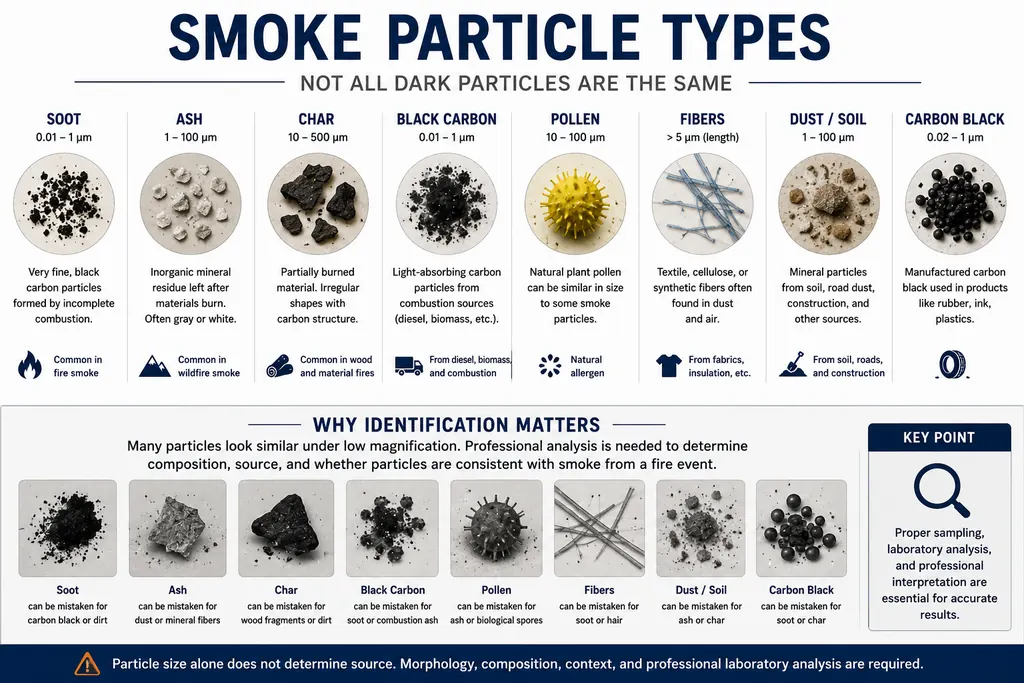
4. Soot, ash, char, PM2.5, and black carbon
| term | what it is | interpretation caution |
|---|---|---|
| PM2.5 | Fine particles ≤ 2.5 µm[2] | A size/health category, not a fire-forensic identity — sensors measure concentration, not source |
| Soot | Carbon-rich byproduct of incomplete combustion; often carries PAHs[5] | Also produced by fireplaces, candles, cooking, diesel, tobacco — presence alone doesn't identify one source |
| Ash | Inorganic/organic residue left after burning; WUI ash may include trace metals from structures[7] | Fine ash mixes into ordinary indoor dust |
| Char | Partially burned material fragments | Larger and more morphologically recognizable than fine soot |
| Black carbon vs. carbon black | Black carbon = combustion-related; carbon black = manufactured (rubber, inks) | ASTM D6602 exists to distinguish them — dark particles are not automatically fire soot[8] |
5. What it can and cannot prove
- Presence — combustion-related particles in collected samples
- Distribution — localized, room-specific, HVAC-distributed, attic-related, or building-wide
- Consistency with fire exposure — combined with event history, wind, odor, HVAC operation, comparisons
- Cleaning scope — surfaces, contents, HVAC, attics, insulation
- Clearance — whether targeted residues were reduced after remediation
- Documentation — converts "the house smells smoky" into lab evidence
- That a specific fire caused every particle found
- That a building is unsafe
- That all odors are smoke-related
- That VOCs are absent
- That no hidden contamination exists outside sampled areas
- That insurance must pay
- That full remediation is necessary
6. When it's most appropriate
Most useful when: the building was near a wildfire, structure, apartment, commercial, or vehicle fire; the property did not burn but odor or ash exposure occurred; there is visible ash or dark residue; HVAC ran during the event or odor returns when it operates; the carrier says "no visible charring, no damage"; cleaning was performed but residue remains; attic, crawlspace, duct, or contents contamination is suspected; the occupancy is commercial, multifamily, or healthcare; or post-remediation clearance needs documentation.
"There was a fire nearby. My property did not burn. Now I smell smoke, see ash, or worry particles entered the home — and my insurance company is minimizing it." That person needs documentation, not generic restoration marketing.
7. Sampling design: the most important part
The lab result is only as good as the sampling plan. NIOSH guidance emphasizes that strategy, collection method, surface characteristics, contamination distribution, and comparability across locations all drive interpretation.[9] A strong plan starts with a hypothesis — "smoke entered through the HVAC fresh-air intake and distributed to supply registers," "wildfire ash entered attic ventilation and deposited on insulation." Without a hypothesis, sampling is random, and random sampling produces weak reports.
Pre-sampling investigation: document the fire event (type, incident number, date, distance, wind and plume direction, evacuation zone, AQI history, visible fallout); building conditions (windows/doors, HVAC operation, fresh-air intake, filter condition, attic and crawlspace ventilation — EPA's identified entry routes[1]); occupant observations (odor locations and timing, cleaning attempts, fireplace/candle/tobacco/cooking history); and prior cleaning or disturbance, which can change surface results dramatically.
8. Common sampling methods
9. Lab analysis methods
Optical microscopy (polarized light, reflected light, darkfield) identifies particles by size, shape, color, opacity, and morphology — distinguishing char, ash, soot/black carbon, minerals, fibers, rubber, corrosion products, fungal material, and general dust. ASTM D6602 addresses distinguishing manufactured carbon black from other environmental particulates, noting soot varies widely with fuel and combustion conditions;[8] fire/smoke laboratories apply D6602-based approaches to char, ash, and soot evaluation.[11] SEM-EDS adds high-resolution imaging and elemental composition — valuable in contested or high-value claims. Chemical analysis (PAHs, metals) can be added where the hypothesis justifies it — EPA notes WUI smoke can include trace metals from burned built materials[7] — but adds cost without value if the question is simple presence or clearance.
10. Present/absent vs. quantitative results
Qualitative (detected / trace / moderate / heavy / consistent with) is common in fire-residue screening but vulnerable if terms are undefined. Semi-quantitative (rare / few / common / abundant, percent area, particles per field) helps compare affected vs. unaffected areas. Quantitative (mass, surface loading, counts) can be stronger — but only with appropriate sampling area, collection efficiency, and method. A precise result from a poor sample is still a poor result.
11. Background samples and confounders
Buildings are not clean rooms. Comparison samples (unaffected room, outdoor surface, neighboring unit, attic vs. living space, HVAC supply vs. return) turn "particles exist" into "the pattern, type, amount, and distribution are meaningful compared with expected background."
Confounders that can look like smoke damage: candle soot, fireplace use, cooking aerosol, tobacco/cannabis smoke, incense, diesel exhaust, attached-garage emissions, rubber particles, carbon black, construction dust, asphalt roofing particles, soil minerals, corrosion, fungal growth, old fire residue. A strong report discusses confounders; a weak report ignores them.
12. HVAC, attics, and contents
HVAC systems are both pathways and reservoirs.[1][12] Sample return grilles, supply registers, filter media, plenums, duct interiors, coil areas, fresh-air intakes. The strongest HVAC claim documents that the system ran during the event, filter dates are known, odor increases when it runs, samples show combustion particles, and comparisons support distribution. HVAC explains how a local smoke event becomes building-wide.
Attics and crawlspaces are ventilated by design — smoke and ash enter through soffit, ridge, and gable vents, roof penetrations, and foundation vents. Insulation matters because it is porous and effectively uncleanable: residue on a painted windowsill is one level of impact; particles embedded in attic insulation is a much bigger scope question.
Contents: clothing, bedding, upholstery, mattresses, rugs, books, electronics, artwork, inventory. FEMA notes soot and ash can make porous materials difficult or nearly impossible to clean.[6] Sample representative categories, not every object.
13. Wildfire and commercial investigations
The IICRC/RIA/CIRI wildfire restoration guide states that for structures without direct flame, radiant heat, or hot turbulent smoke plume impact, restoration is primarily thorough professional cleaning — with sampling decisions made with an assessment professional.[14] Wildfire smoke impact is not automatically demolition-level damage — but it can justify assessment, targeted cleaning, HVAC evaluation, contents cleaning, and clearance documentation.
Commercial and multifamily plans (apartments, HOAs, hotels, offices, schools, medical) add HVAC zones, tenant complaint logs, occupancy schedules, filter-change records, roof units, corridors, pressure relationships, and cleaning-contractor logs. ASHRAE Guideline 44-2024 addresses occupant protection in exactly these building types.[13]
14. Chain of custody
The documented path of each sample from collection to lab receipt: sample ID, type, location, date/time, collector, method, surface area, field notes, photos, packaging, transfer record, lab receipt, requested analysis, report number. Without it, the opposing side can question whether the sample came from the stated location or was mishandled.
15. Reading the lab report
Look for: sample identification ("Kitchen windowsill, north wall, pre-cleaning" — not "Sample 1"); method (PLM, reflected light, SEM-EDS, ASTM D6602 basis); target particles specified; result format; background comparison; limitations (strong reports have them — weak reports pretend the method answers everything); and professional interpretation. The lab report is evidence; interpretation turns it into an argument. A complete report adds the event description, exposure timeline, HVAC status, odor observations, cleaning history, sampling map with photos, chain-of-custody forms, confounder discussion, recommended scope, and reviewer credentials.
16. How carriers attack weak particle testing
"No background samples" (the strongest attack) · "sample locations were cherry-picked" · "the particles could be candles, cooking, fireplace, or diesel" (valid unless alternatives are addressed) · "the sample was collected after cleaning" (explain the history) · "the lab did not identify the source" (labs identify particle character; attribution requires professional interpretation) · "the report overstates the data" (never claim the lab "proved wildfire smoke damage throughout the home" when it shows trace particles on two samples).
17. Clearance testing
Initial testing asks: is smoke-related residue present? Clearance testing asks: were the targeted residues reduced or removed from sampled areas after remediation? Base clearance on pre-remediation findings, the written scope, cleaning and containment methods, HVAC actions, post-cleaning visual and odor assessment, comparison samples, and post-remediation lab results. A clearance sample without a pre-cleaning baseline can still be useful — but interpret cautiously.
18. Field workflow
Frequently asked questions
Sources
- U.S. EPA. Wildfires and Indoor Air Quality (IAQ).
- U.S. EPA. Particulate Matter (PM) Basics.
- U.S. EPA. Wildfire Smoke — A Complex Mixture.
- CDC/NIOSH. Wildland Fire Smoke.
- ATSDR. Polycyclic Aromatic Hydrocarbons (PAHs).
- FEMA. Homeowner's Guide to Risk Reduction and Remediation of Residential Smoke Damage (Marshall Fire MAT, 2025).
- U.S. EPA. Wildland Fire Research: What's in Smoke?
- ASTM International. ASTM D6602 — sampling and testing of possible carbon black fugitive emissions or other environmental particulate.
- NIOSH. Surface Sampling Guidance, Considerations, and Methods in Occupational Hygiene.
- ASHRAE. Guideline 44-2024 Fact Sheet — PM2.5 sensors, MERV 13 filtration.
- Pinnacle Laboratory. Fire and Smoke Residue Testing — example of ASTM D6602-based PLM practice.
- IICRC. ANSI/IICRC S700-2025 Standard for Professional Fire and Smoke Damage Restoration.
- ASHRAE. Wildfire Response Resources / Guideline 44-2024.
- IICRC/RIA/CIRI. Technical Guide for Wildfire Restoration.
- AirNow. Wildfire Smoke: A Guide for Public Health Officials.